
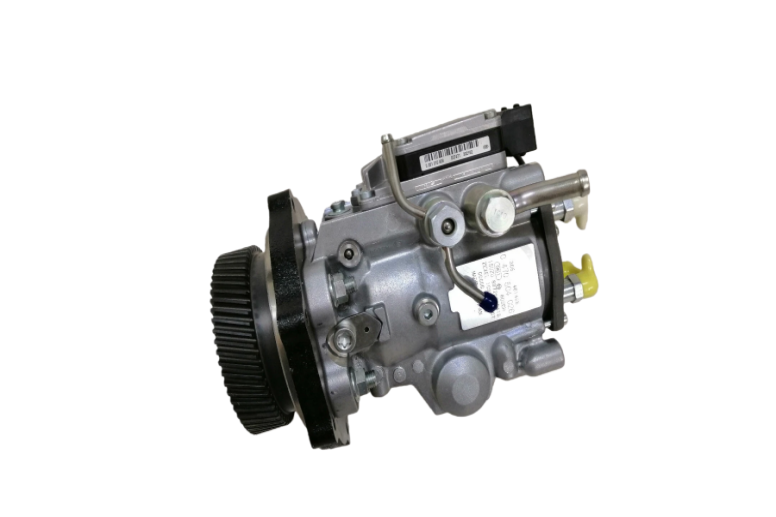
The following is what you want to know about Bosch VP44 diesel pump
The Bosch VP44 (Radial Piston Distributor Pump) represents a significant technological leap from its mechanical predecessors. Introduced in the mid-1990s, it was one of the first widely adopted electronic diesel control (EDC) pumps. It bridged the gap between purely mechanical systems and the later common-rail technology, offering precise electronic control for better performance, efficiency, and emissions compliance.Main Technical Advantages
Electronic Solenoid Control (The Core Advantage):
Precise Timing & Quantity: The injection timing and fuel quantity are controlled by an Electronic Control Unit (ECU) based on sensor inputs (engine speed, load, temperature, etc.). This allows for optimal injection characteristics across the entire engine map, improving power, fuel economy, and reducing cold-start smoke.
Dynamic Timing Adjustment: Injection timing can be varied dynamically during operation, which was impossible with mechanical pumps. This optimizes combustion for different loads and speeds.
Integration with Vehicle Systems: The ECU could communicate with other vehicle systems (e.g., traction control), enabling features like cruise control and torque limitation.
High Injection Pressure:
The VP44 could generate significantly higher injection pressures (up to ~2000 bar in its later "VP44-S3" generation) compared to its mechanical ancestor, the VE pump. Higher pressure leads to better fuel atomization, more complete combustion, lower emissions (especially particulates), and increased engine power.
Pilot Injection Capability:
A key feature of later VP44 generations (like the VP44-S3 with "DSLA" nozzles). The ECU can command a very small, preliminary injection (pilot injection) before the main injection event.
Advantage: This gently begins the combustion process, reducing the sharp pressure rise and the characteristic "diesel knock." The result is significantly smoother, quieter operation and lower nitrogen oxide (NOx) emissions.
Self-Adaptation & Diagnostic Capabilities:
As part of an electronic system, the VP44 pump and its ECU could perform self-diagnostics, store fault codes, and even implement limp-home modes in case of sensor failures, enhancing reliability and serviceability.
Key Structural Features
The VP44's design is fundamentally different from axial-piston distributor pumps (like the Bosch VE). Its structure enables its high-pressure capability and electronic control.
Radial Piston Design (The Namesake Feature):
Instead of a single axial piston (as in the VE pump), the VP44 uses three or four radial pistons (plungers) arranged like a star around a central cam ring.
How it works: An internal electric motor (controlled by the ECU) drives the pump shaft. As the shaft rotates, the plungers are forced outward by the cam ring's lobes, generating the extremely high fuel pressure. This multi-piston design is inherently stronger and more balanced for high pressure than a single-piston design.
Integrated High-Pressure Pump and Distributor Head:
The radial pistons generate pressure in a central high-pressure chamber. A rotating distributor sleeve, with a single outlet port, then directs this high-pressure fuel to each cylinder's injector in the correct firing order. This integrates the pressure generation and distribution functions into one compact unit.
Integrated Electronic Control Unit (ECU):
The most recognizable structural feature is the "brain box" – a black electronic module bolted directly to the top or side of the pump housing.
This ECU contains the driver for the high-speed solenoid valve and processes all sensor data. Its integration simplifies wiring but also makes it susceptible to heat from the engine (a common failure point).
High-Speed Solenoid Valve (HSV):
This is the key actuating element. It is an electrically controlled valve positioned between the high-pressure chamber and the outlet.
Function: The ECU pulses the solenoid to open and close this valve with extreme precision. The start of injection is determined by when the valve opens. The end of injection and the fuel quantity are determined by how long the valve stays open. This is known as the "spill control" principle.
Fuel Lubrication & Cooling:
Unlike older pumps lubricated by engine oil, the VP44's internal moving parts are lubricated and cooled solely by the diesel fuel flowing through it. This makes fuel quality and cleanliness absolutely critical. Contaminated or low-lubricity fuel can lead to rapid pump wear and failure.
Internal Vane-Type Transfer Pump:
Located at the pump's inlet, this low-pressure pump draws fuel from the tank and feeds it to the high-pressure radial pistons at a consistent supply pressure (typically 5-10 bar). This ensures the high-pressure section is always primed and helps cool the pump.
The Bosch VP44 was a pivotal system applied during a specific transition period in diesel technology. Its applications are defined by the era (late 1990s to mid-2000s) and the need for a significant upgrade in performance and emissions control over purely mechanical pumps.
Here are its main application scenarios and the specific devices (vehicles/engines) it was used in.
Main Application Scenarios
Passenger Cars Requiring Euro 3 Emissions Compliance:
This was the primary driving force. The VP44's electronic control, high pressure, and pilot injection enabled car manufacturers to meet the stricter Euro 3 emission standards (introduced circa 2000) without moving to the then more expensive common-rail technology. It was the "high-tech" solution for mid-to-upper segment diesel cars of its time.
Performance-Oriented and Refined Diesel Vehicles:
Its ability to reduce noise (via pilot injection) and increase power output made it ideal for manufacturers marketing "quieter," more powerful, and more comfortable diesel cars—aiming to appeal to gasoline engine customers.
Light Commercial Vehicles (Vans & Small Trucks):
The balance of good fuel economy, reliable power, and improved driveability made the VP44 a popular choice for 2.5L - 3.0L engines in vans and light trucks, where durability and operating cost were key.
Agricultural & Industrial Machinery (Limited):
While less common than in road vehicles, some agricultural tractors and construction equipment used VP44-based systems when they needed a step up from mechanical injection for better control and efficiency, but were not yet ready for full electronic common-rail.
Specific Devices & Applications (By Manufacturer/Vehicle)
The Bosch VP44 is strongly associated with a few key automotive groups and their engine families.
1. General Motors (Opel/Vauxhall, Saab, Isuzu) – The MOST Prominent User:
Engine: The famed 2.0 DTI / 2.2 DTI (Y20DT / Y22DTR) and 2.5 TDI (Y25DT) family.
Vehicles:
Opel/Vauxhall: Vectra B/C, Signum, Omega B, Sintra, Frontera.
Saab: 9-5 (NG), 9-3 (OG).
Isuzu: Rodeo / MU (with the 3.0L 6SE1 engine - a different but related VP44 application).
Note: These applications are infamous for VP44 ECU failures due to heat, making them a common repair case.
2. Fiat Group (Alfa Romeo, Fiat, Lancia) – The "JTD" Pioneer:
Engine: The early versions of the revolutionary 1.9 JTD / 2.4 JTD engines (first and second generation, often denoted as 8v).
Vehicles:
Alfa Romeo: 156, 166, 147.
Fiat: Stilo, Ulysse, Scudo, Ducato.
Lancia: Thesis, Lybra.
Significance: Fiat heavily marketed the "JTD" with VP44 as a high-performance, clean diesel technology. Later generations switched to common-rail.
3. Renault:
Engine: The 2.2 dCi (G9T engine).
Vehicles: Renault Espace IV, Laguna II, Vel Satis, Trafic. These applications also commonly feature the high-pressure S3 variant with pilot injection.
4. Ford (Limited Use in Europe):
Engine: The 2.0/2.4 DI Duratorq "Puma" engine (developed in conjunction with PSA).
Vehicles: Ford Transit (1998-2006), some Ranger models.
5. Light Trucks & Vans:
Engine: Various 2.5L - 3.0L engines from Iveco (Daily), and as mentioned in the Fiat Ducato/Scudo, Ford Transit, and Renault Trafic.
How to Identify a VP44 Pump in Practice:
If you are looking at an engine, the VP44 is easily recognizable by its key structural feature:
The prominent, rectangular "brain box" (ECU module) bolted directly onto the pump body, with a large wiring harness connector. This is its most distinctive visual trait compared to mechanical pumps (no box) or later common-rail pumps (ECU is separate, on the engine or in the car's computer box).